Researchers Uncover Role of Environmental Molecules in Static Electricity
Static electricity remains one of the least understood phenomena in basic physical science despite occurring routinely in daily life and throughout nature, according to physicist Scott Whitakitus [check] of the Institute of Science and Technology Austria in Vienna. Speaking with Physics World online editor Margaret Harris at the American Physical Society's Global Physics Summit in Denver, Colorado, Whitakitus detailed the challenges of contact electrification and recent insights gained from studying insulating oxides.
Whitakitus noted that static electricity is the charge left on objects after they touch and exchange charge. Because physical systems from desert dust storms to volcanic ash clouds involve particles contacting one another, static electricity governs broad natural processes. Yet, Whitakitus explained that researchers historically faced extreme difficulty reproducing experiments. Different laboratories produced conflicting rankings of material charging, known as triboelectric series, leading theorists to produce widely varying hypotheses ranging from acid-base chemistry to electronic band structures and flexoelectricity.
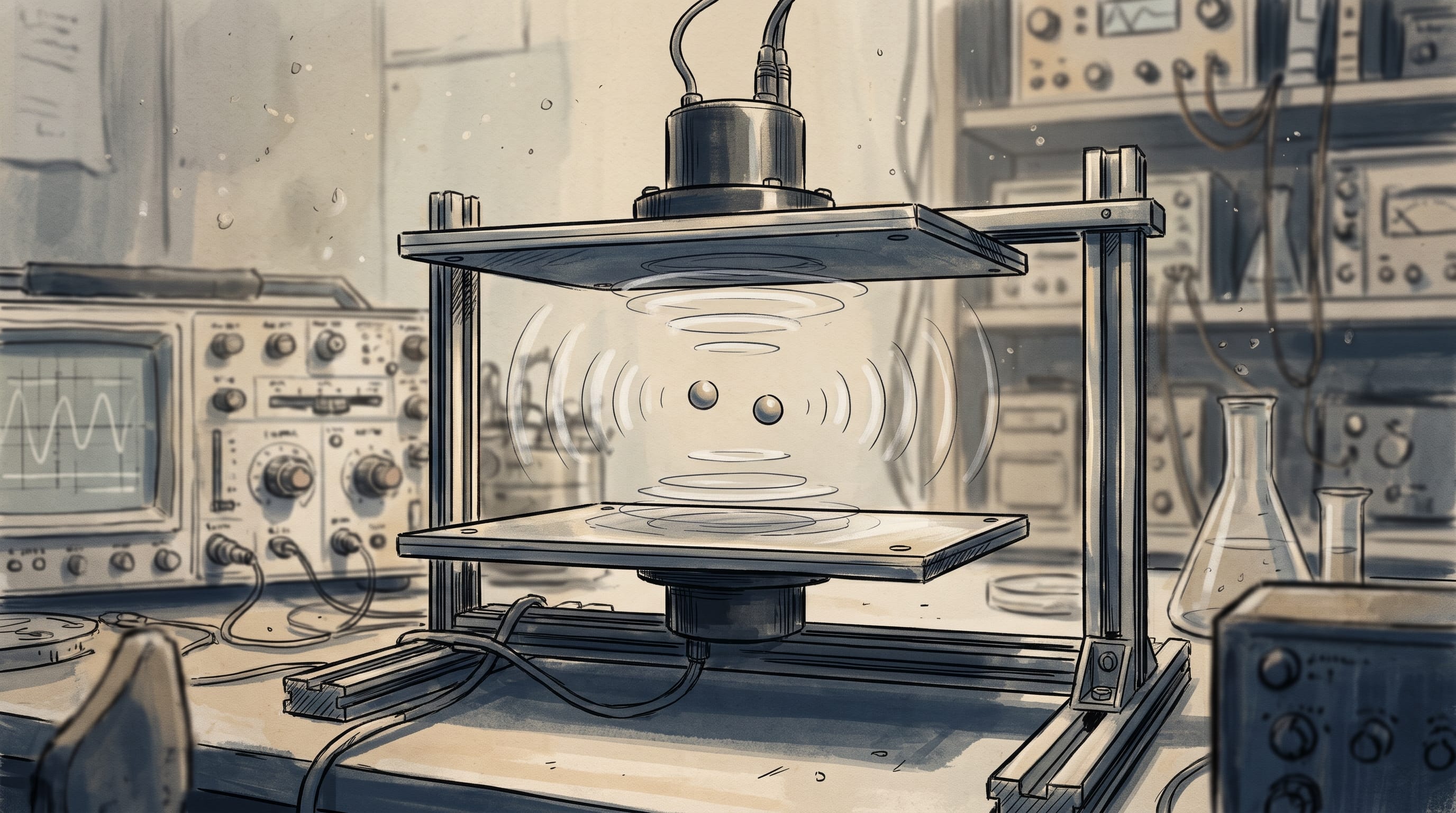
To simplify the problem, Whitakitus and his team chose to study why identical materials exchange charge when brought together. By using identical materials such as silicon dioxide, quartz, and alumina, the researchers aimed to eliminate confounding material differences. To avoid contaminating the charges during manipulation, the team employed acoustic levitation, which suspends particles in air using sound waves formed between a speaker and a reflector plate. By applying an external electric field to shake the levitated particles, the researchers measured charges on 500-micron spheres with a precision of plus or minus 500 electrons.
During their investigations, the team observed that the environmental history of the materials caused sharp discrepancies in charging behavior. While researchers traditionally suspected absorbed water on oxide surfaces to be the primary cause, experiments involving heating to bake off water produced inconsistent results. Instead, the team discovered that small organic, carbon-hydrogen molecules present in ambient air accumulate on surfaces over time.
Whitakitus reported that when two identical silica surfaces touch, a surface stripped of these adventitious carbon molecules charges negatively relative to one coated in carbon. Surface scientists working with ultra-high vacuum equipment confirmed that these carbonaceous molecules reappear on cleaned surfaces within hours or days, even in vacuum chambers.
While Whitakitus clarified that the nanoscale physical mechanism linking carbon accumulation to charge transfer remains unknown, he identified the carbon layer as the key symmetry-breaking parameter for insulating oxides. He noted that other materials operate differently; in polymers, for instance, a sample's contact history determines its charge sign. For their next steps, Whitakitus and his team plan to build an apparatus that measures charge exchange and carbon accumulation simultaneously, alongside experiments that introduce artificial molecules to test how specific chemical functional groups influence charging.
Show notes
In this episode, Physics World online editor Margaret Harris speaks with Scott Whitakitus [check], a physicist at the Institute of Science and Technology Austria in Vienna, at the American Physical Society's Global Physics Summit in Denver, Colorado.
Whitakitus describes how static electricity occurs whenever objects touch and explains the challenges of reproducing contact electrification experiments. He details his laboratory's use of acoustic levitation to measure charge exchange between identical insulating oxide particles, such as silica, without unintended physical contact.
The discussion covers the discovery that adventitious carbon-based molecules—rather than absorbed water—accumulate on surfaces from the environment and dictate charging behavior. Whitakitus also outlines future research plans, including simultaneous charge and surface analysis, as well as testing custom molecules.
Chapters
- 00:00 Introduction to the Podcast
- 01:08 What Is Static Electricity and Why It Matters
- 02:02 Origins in Granular Physics and Experimental Challenges
- 03:26 Scientific Cluelessness and the Triboelectric Series
- 05:53 Colliding Identical Materials Using Acoustic Levitation
- 08:36 Measuring Charge and the Impact of History
- 10:23 Debunking the Water Hypothesis and Finding Carbon
- 12:38 Ultra-High Vacuums and Adventitious Molecules
- 14:06 Symmetry-Breaking Mechanisms Across Material Classes
- 16:40 Future Research and Tailor-Made Molecules
- 18:07 Conclusion and Credits
Transcript
[00:08] spk:0: Hello and welcome to the Physics World weekly podcast. Our guest in this episode is Scott Whitakitus, who is a physicist at the Institute of Science and Technology Austria in Vienna. Scott studies soft electrified materials, and he's particularly interested in static electricity, which is one of those everyday phenomena that turns out to be much more complicated than you might think for reasons that you'll hear about in a moment.
[00:44] spk:0: Physics World's online editor Margaret Harris spoke to Scott at the American Physical Society's Global Physics Summit, which took place in Denver, Colorado earlier this year. Here's that conversation.
[01:08] spk:1: First off, big question. What is static electricity and why is it important to study it?
[01:14] spk:2: Static electricity is essentially it's the charge that's on objects after they've contacted and exchanged charge. Uh so you can think of things like rubbing a balloon on your hair. The balloon and the hair initially start out electrically neutral, but when you touch them together, they exchange some charge, and when you pull them apart, one is now positively charged and one is negatively charged.
[01:38] spk:2: Why is it important? It's important because it occurs whenever any two objects touch. So literally your coat's touching the surface right now, your pants touching the chair, your hand touching the phone. It's happening all the time. Uh that means it happens in nature all the time, and therefore there are tons of physical systems in nature whose behavior is highly governed by static electricity.
[02:02] spk:1: How did you become interested in this topic?
[02:05] spk:2: I became interested by chance. So during my PhD, I worked on problems in granular physics. So systems of lots of interacting grains, like sand grains for example. Uh and these are systems where the constituents are constantly rubbing, sliding, rolling all over each other, uh and therefore they get electrically charged.
[02:26] spk:2: Most of the time in granular physics, people try to ignore this, but during my PhD, my advisor decided maybe we should pay attention to it. Uh and we had no idea the kind of can of worms we were opening up.
[02:39] spk:1: Why is it such a can of worms?
[02:42] spk:2: Oh man. It's a can of worms because we we don't really know what's going on, and if you look at the literature, the experiments are extremely difficult in the sense that you do one thing one day and you can't reproduce it again. And there are all sorts of practical reasons why the irreproducibility is there. And as a result of the experiments not being able to get things very clean, uh the theorists have basically been unconstrained.
[03:08] spk:2: There's nothing to prevent them from thinking all sorts of different fantastical ideas of how it works. Uh so when you look at the literature, there are a bunch of experiments that are inconsistent with each other and a bunch of theories that are unconstrained. And so if you're a graduate student looking at it for the first time, it's a can of worms. It's just chaotic.
[03:26] spk:1: So what is it we exactly we don't understand about what happens when two objects contact each other? I mean, naively you might think that this surely there's some sort of microscope these days that can show us what's happening there.
[03:38] spk:2: There is no such microscope, and I would pay a lot of money if there were. We don't know. I I I'm very uh conservative, and I think we basically don't know anything. We don't know what charge is being exchanged. We don't know even what the differences between two materials that causes them to exchange charge. So if I give you balloon and hair for example, I don't know if it's the electronic structure of the balloon.
[04:03] spk:2: I don't know if it has something to do with the chemistry of the balloon, maybe the acid-base properties. Uh some people have suggested it has to do with piezoelectricity or flexoelectricity, but but we don't actually know. You know, give me a a parameter of the balloon like conductivity, electronic structure, work function. We don't know what parameter matters.
[04:24] spk:2: Um so I you know, that's why I say we're basically clueless.
[04:28] spk:1: So what do the experiments that have been done, what do they typically show?
[04:32] spk:2: I think a typical experiment is to well, a very classical experiment is to take a group of materials, say five materials, ideally try touching every pair together and then seeing if there's kind of an ordering, which one charges the most positively, which one charges maybe negative to the first one but positive to the rest, etc.
[04:53] spk:2: And so this is called a triboelectric series. There are lots of instances historically where people have found triboelectric series in the data they work with. And then of course, the goal is to try to correlate the triboelectric series with some property of the materials so we can identify the property that matters. But the thing is when you look at those typical kinds of experiments, one group will say, hey look, we got this series.
[05:16] spk:2: It orders this way. It's because of the acid-base properties of the materials. And the next one will say, hey look, it has to do with the electronic structure of the materials. Um and so you you get these very, you know, classical kinds of experiments. The series from one lab to the next don't agree, and the interpretations from one lab to the next don't agree. Does that answer your question?
[05:35] spk:1: I think it does. Yeah, everybody's trying to do their best. It's just such a messy system that it's hard to see the forest for the trees, I guess.
[05:42] spk:2: Yeah, I might get one set of results in my lab, and so I think it's the interpretation uh that makes sense to me, but you do it in your lab and you get a different triboelectric series and you get a different interpretation.
[05:53] spk:1: So what specific question have you been trying to answer in the latest run of work you've been doing for the past couple of years?
[05:58] spk:2: So we've been concentrating on a very particular and quirky aspect of this topic. Most of the experiments I just described, people rub different materials together.
[06:10] spk:2: We're working with always rubbing the same materials together. Um and it 's been known for a long time that even if you touch you know, two balloons together so to speak, they always exchange charge. The rationale for working with identical materials is that when you work with different materials, you know, they differ in so many possible ways, and it's hard to nail down the one that matters.
[06:33] spk:2: But if you work with materials that should be nominally identical, it might be easier to find the thing about them that's different. And then we can actually hone in on what is different faster. So basically we study why identical things exchange charge.
[06:47] spk:1: And what specific identical things are you looking at? Can you describe your experimental setup?
[06:51] spk:2: Sure. In the recent work, we work with oxides, uh specifically oxides that are electrical insulators. Um these are materials like silicon dioxide or quartz or alumina. Uh they're actually very common materials on the surface of the Earth or on other planets. Um in fact, they're the most common material on the surface of the Earth. We're interested in these materials because they're so common, so they really matter in natural settings like in the sand of a dust storm in the Sahara or in the ash cloud of a volcano.
[07:23] spk:2: And what we do in our experiments is we take a particle of one material, so silica say, and we actually make it float in the air with acoustic levitation. So acoustic levitation is a way to levitate objects with sound. We can then take that particle and make it collide with a plate made of the same material also using the acoustic levitation so we get a nice clean contact where charges exchanged.
[07:50] spk:2: And then finally we can measure how much charge was exchanged in that contact also with the acoustic levitation. And the reason we use acoustic levitation is because a giant pitfall of these experiments is if you touch the thing you want to measure the charge of to manipulate it, you change the charge.
[08:08] spk:1: So Schrodinger's sphere basically.
[08:10] spk:2: You You can't Yeah, you can't uh interact with your system without changing it. So you need to somehow interact with your system in a touch-free way. And like I said, historically this is a big pitfall is adding charge to objects that is not wanted. And so acoustic levitation is a wonderful tool uh because we can hold things without touching them.
[08:28] spk:1: So how do you actually measure how much charge is on these little spheres that are levitating acoustically above a plate?
[08:36] spk:2: So imagine I have a a little sphere in an acoustic trap. The acoustic trap is basically a speaker and a reflector plate, uh and the particle gets attracted to the node of the standing wave in that speaker reflector geometry. It looks like it's on a spring, right? Because everything that's held at a potential energy minimum looks like it's on a spring.
[08:57] spk:2: So what we actually do is we apply an external electric field to shake it on that acoustic spring, and then by looking at how much it shakes and responds to the external field, we can measure the charge. Um and it's actually It turns out to be wonderfully precise. Uh so I can show you a grain, a particle, a sphere that's uh 500 microns in diameter. It's big enough to see with your eye.
[09:19] spk:2: And we can tell you how much charge it has on it to plus or minus 500 electrons. So you know, kind of a countable number of electrons on a macroscopic object.
[09:28] spk:1: Wow. Yeah. So I think one thing you've worked out is that there are history-dependent effects. Like it matters what's happened to this little silicon dioxide sphere before you do an experiment on it.
[09:40] spk:2: It's extremely frustrating. Uh it was extremely frustrating for a long time because we could not get consistent results uh from one experiment to the next. Um in general, the idea that the history of an object matters in this effect had not really been proposed. And for the systems we've been working with, we found out that when we really pay attention to the history and keep track of uh in the case with these oxides, the environmental history, then we can start to see patterns that make sense.
[10:13] spk:2: But indeed it was extremely frustrating before we understood that the history was the the key variable.
[10:18] spk:1: So what is it about the history that matters? How did you figure out what was going on?
[10:23] spk:2: Well, we had been suspecting like many people that absorbed water on the surface of a an oxide particle or an oxide plates was the thing that mattered. So that was a suspicion that a lot of people have had for a long time. And so we were looking for ways to kind of change the water on the surface. One of the simplest ways is actually to to bake an object, to heat it up to an elevated temperature to get rid of the water.
[10:49] spk:2: But when we did that, we saw number one that the changes we expected were not going in the right direction, and in fact they were going kind of in random directions. And so this suggested that it maybe you know, the baking certainly had an effect, but it wasn't related to water.
[11:06] spk:1: So what if it wasn't due to water, what was it about the history of these spheres that was causing this different patterns of charging?
[11:15] spk:2: So what we learned is that when an object is sitting in some environment, like the air we're sitting in right now, molecules from the environment absorb to the surface. They get stuck to the surface. The molecule that everyone thinks about the most is water. That 's why we were thinking about it. But water is not the only molecule in town. In every environment, there are all sorts of small organic molecules, organic in the kind of carbon-hydrogen chemistry sense, not like you know, pieces of hamburger or something, but little molecules that exist naturally in our environment, in the environment of Mars, in the environment of space that also attach to the surface.
[11:51] spk:2: And so while we were thinking so hard that it must be the water on the surface, it turns out it's these carbon-based molecules that were the ones that actually mattered. And that's why following the water route led us off track.
[12:03] spk:1: So is it the case like the more carbon on the surface means it's more likely to charge positively or negatively? Do you know the difference?
[12:10] spk:2: That's the basic trend we see. If we have one surface of one material, say silica, uh that has a lot of carbon on its surface, because we've left it in an environment for a long time and has therefore acquired a lot of this carbon, and we have another surface that by some experimental means has been stripped of carbon, the one that has no carbon charges negatively to the one that has carbon.
[12:35] spk:2: Uh and that's the key thing we found.
[12:38] spk:1: So would it make sense to if you wanting to understand these charging relationships to put the particle in a in a vacuum, an ultra-high vacuum, and remove all this carbon stuff from the environment?
[12:50] spk:2: That's a funny question because we actually we actually were cued into the idea of these carbon molecules mattering from surface scientists who work in ultra-high vacuum. Whenever they want to study a surface where they can you know, really for example use a a vacuum AFM to see every atom on a material or to you know, do some kind of spectroscopy or something on a pure material.
[13:13] spk:2: The first step they do after they put it in the vacuum chamber is get rid of all of the carbon. And so when we started working with surface scientists, they said, oh yeah, we put your sample in the vacuum chamber and got rid of the carbon and here's your data. Uh and we had to do a double take. What, you got rid of the carbon? What do you mean? The funny thing is is that when they do their experiments, they put it in, they get rid of the carbon, they do their thing.
[13:35] spk:2: If they leave the sample in the vacuum chamber overnight, the carbon's all back. So there's really not an environment where you can get rid of this, uh not even the best ultra-high vacuum. It's really I mean, every environment we know of has these adventitious molecules uh that tend to cover a surface you know, on a kind of hours to days time scale.
[13:57] spk:1: So just get all schmutzed up after
[13:58] spk:2: Schmutzed up. In fact, that was the word we were using when we first were you know, thinking what was on the surface. The word we had for it was schmutz.
[14:06] spk:1: So what's the mechanism behind this schmutz affecting charging? Do you know what's going on at sort of a nano-scale level?
[14:14] spk:2: We don't know. We don't know what the mechanism is that actually causes the schmutz to matter. We just know the schmutz matters. So the claim you know, that we're making is we've identified the symmetry-breaking parameter that causes two identical materials to be different. At least in the case of oxides, I wouldn't extend it beyond that. Um but you know, we don't we don't know the mechanism. Now the the great goal is to of course use the fact that we know what matters to focus more on what how it matters.
[14:40] spk:2: Yeah.
[14:41] spk:1: You mentioned it's just for oxides that you're saying that this is true. Are there other things that are responsible for a difference symmetry-breaking and charging for other materials?
[14:50] spk:2: Yeah, so the experiments we've done uh in this current project are all with uh oxides and specifically insulating oxides. So silica, quartz, alumina, sapphire, spinel, magnesium oxide. They're all materials that are electrically good insulators. They are very similar in the sense that they they have high surface energies, which means they readily absorb these these adsorbates, these molecules.
[15:15] spk:2: And so they're all very similar, and we found this uh you know, this carbon effect exists for all of them that we've tried. Um and that 's about altogether you know, probably close to 10 different of these oxides. This class of materials is It's um inorganic, meaning that the material itself does not really have a bunch of organic chemistry going on inside. There are other materials like polymers for example, plastics where we see very different effects.
[15:41] spk:2: Um so in polymers, we actually see that the contact history of a sample matters. So literally a sample that has touched more things than another sample will charge with a sign based on how many things it's touched. So there are for sure different mechanisms going on for different material classes. Uh and this is what's causing us to be conservative and cautious about extending claims beyond what we have seen.
[16:08] spk:2: I would not be surprised if this carbon effect exists pretty broadly for inorganic materials that are poor electrical conductors. Um so you know, an example of that would be like calcium fluoride for example. It's an inorganic material. In many ways, it's very similar to say a piece of silica because it's not a good conductor. Things readily absorb to the surface, but you know, showing it's true for that case would require going and doing those experiments and we just haven't gotten to it yet.
[16:37] spk:1: So what's the next step for you, you and your team?
[16:40] spk:2: So what we want to do is um start to try to understand like you asked, what is the mechanism that makes carbon matter? And we basically have two ideas towards doing that. In the experiments we did so far, you know, we could measure the charge exchange of a sphere and a plate after they'd gone through certain treatments to change the amount of carbon on one surface or the other.
[17:03] spk:2: And then independently in a different setup, we could actually probe the amount of carbonaceous molecules on the surface. But we had to do those at separate times. And so the first thing we want to do is build a setup where we can do those both at the same time so I can watch the evolution of the exchange of charge with the evolution of the growth of this carbon layer on the surface. That's one thing.
[17:25] spk:2: The next thing we want to do is kind of remove all of the natural molecules from the surface and put on artificial ones with specific properties. And then by kind of you know, testing all possible combinations in a catalog of these artificial molecules, maybe that also tells us something about the mechanism. If for example we see trends uh you know, based on kind of the functionality of these molecules.
[17:50] spk:1: So Taylor made schmutz is a
[17:51] spk:2: Taylor made schmutz. That's where That's I should use that in the grant proposal.
[17:55] spk:1: Scott Whitakitus, thank you very much for speaking with us.
[17:58] spk:2: It's been a pleasure. Thank you very much.
[18:07] spk:0: That was Scott Whitakitus in conversation with Physics World's Margaret Harris. Thanks to both of them for a fascinating discussion about static electricity. I'm afraid that's all the time we have for this week's podcast. I'm Hamish Johnston, and our producer is Fred Isles.
[18:29] spk:0: The music for this episode is called 1 3 7, and it was composed and performed by the physicist Philip Moriarty. We'll be back again next week.
Source: Physics World Weekly Podcast
Picture: illustration, not a photograph of the events.
Comments
Related Articles

Audio
Crisis Group Podcast Examines Eritrea's Outlook as Tensions With Ethiopia Persist
In a new episode of Crisis Group's podcast The Horn, Reuters journalist Giulia Paravicini discusses her recent trip to Asmara and how Eritrean officials view Ethiopia's push for sea access, the situation in Tigray and shifting alliances around the Red Sea.